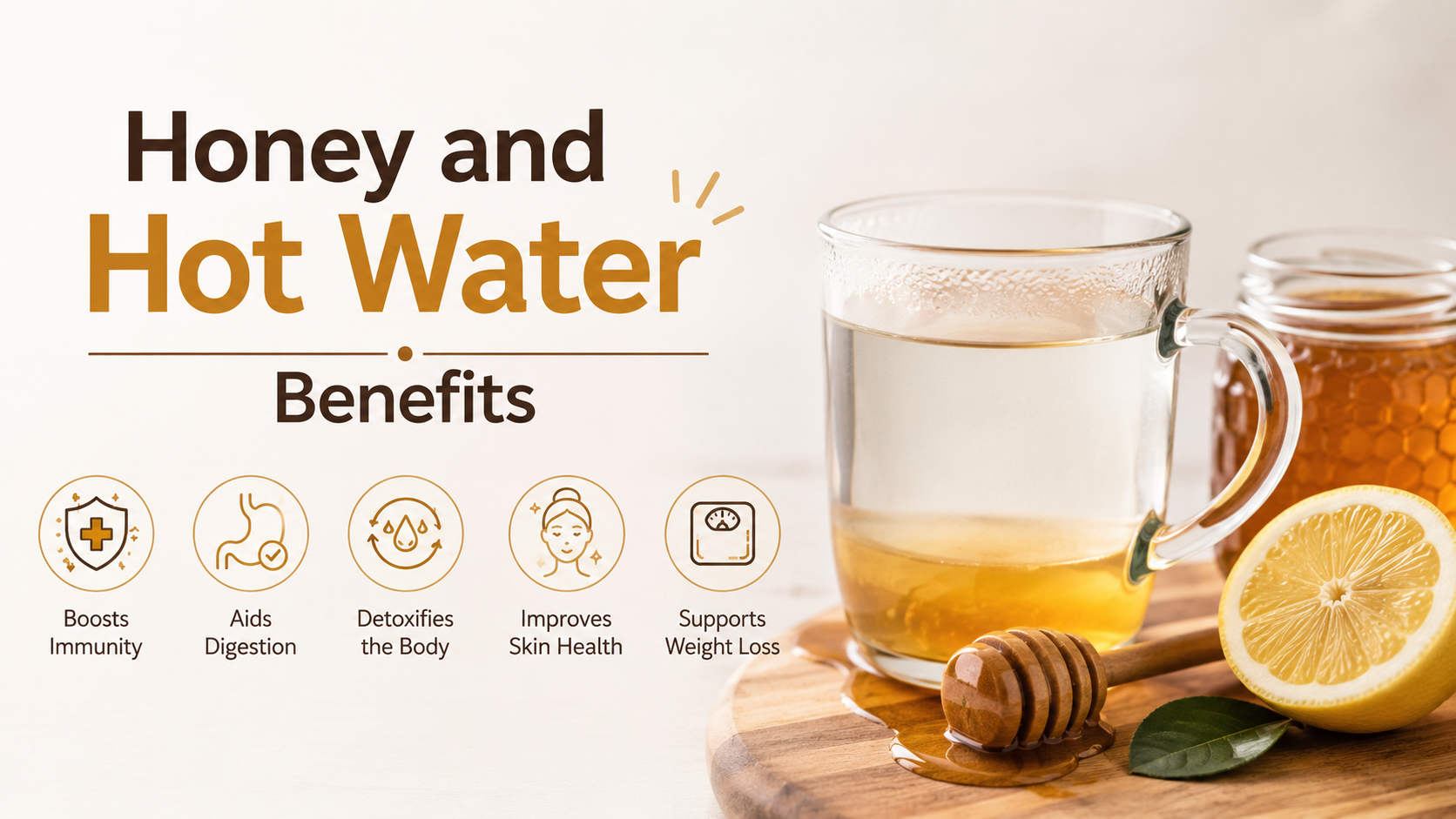
Drinking honey in hot water can soothe a sore throat, calm a nighttime cough, and serve as a lower-processed swap for refined sugar. Honey also supplies antioxidants like flavonoids and phenolic acids. It does not burn fat, detox your liver, or cure disease – and it’s still added sugar, so one to two teaspoons is plenty.
What Actually Happens When You Stir Honey Into Hot Water
Not much chemistry, honestly. Honey is roughly 80% sugar and 17% water, plus trace amounts of enzymes, organic acids, pollen, and plant compounds. Hot water dissolves it fast and thins its texture. That’s the whole mechanism.
The benefits people report come from three separate things, and it helps to keep them apart:
- The warm liquid itself. Warm fluids increase saliva production, loosen mucus, and feel good on an irritated throat.
- Honey’s coating effect. Honey is viscous. It clings to the back of the throat, which is likely why it dampens a cough.
- The swap. If a mug of honey water replaces a 250-calorie flavored latte, the win comes from what you stopped drinking.
Most articles blur those three together and credit honey for all of it. Being clear about which is which makes it much easier to set realistic expectations.
7 Benefits of Drinking Honey and Hot Water
1. It calms a cough – this is the strongest evidence
Honey is one of the few home remedies with real clinical backing for cough. Both the World Health Organization and the American Academy of Pediatrics recognize honey as a cough remedy. A 2018 Cochrane review on honey for acute cough in children, and a 2021 meta-analysis in BMJ Evidence-Based Medicine on upper respiratory tract infections, both found honey performed favorably compared with usual care.
Mayo Clinic suggests half a teaspoon to one teaspoon of honey for children age 1 and older. For adults, research hasn’t shown honey beats standard cough medicine – but it also doesn’t carry the drowsiness and nausea that many cough syrups do.
2. It soothes a sore throat
This one is straightforward. Warm water hydrates dry tissue, and honey’s thickness coats it. A mug of honey water isn’t treating an infection – it’s making the next few hours more comfortable while your immune system does its work.
Add fresh lemon if you like the taste. Lemon adds a small amount of vitamin C and a lot of brightness, but it isn’t doing heavy lifting on its own.
3. It delivers antioxidants – modestly
Honey contains flavonoids and phenolic acids, plant compounds that help counter oxidative stress. Darker honeys – buckwheat, forest, chestnut – generally test higher for antioxidant content than light clover honey.
The honest caveat: to get a nutritionally meaningful dose of these compounds from honey alone, you’d have to eat enough honey that the sugar load would outweigh the benefit. Treat this as a small bonus on top of a diet with real produce in it, not a reason to drink more.
4. It’s a better sweetener swap than table sugar
Honey has a glycemic index that ranges roughly from 31 to 78 depending on the floral source, versus about 65 for table sugar. Some studies suggest honey has a slightly more favorable metabolic effect than refined sugar, including modest improvements in cholesterol markers.
“Slightly better” is the accurate framing. It is not a free pass.
5. It can support hydration habits
This is behavioral, not biochemical. Plenty of people struggle to drink plain water first thing in the morning. Giving water a mild flavor makes the habit stick. If a honey-water mug gets you 10 extra ounces of fluid before 9 a.m., that’s a genuine win – the honey is just the delivery vehicle.
6. It may ease mild reflux discomfort
Research reported in the BMJ suggested honey’s viscosity may help coat the upper gastroesophageal tract, potentially reducing the sensation of acid rising. Evidence here is thin, and reflux has many causes. If you’re dealing with it regularly, this is a conversation for your doctor, not a mug.
7. It’s a gentle nighttime wind-down
There’s no strong sleep research on honey water specifically. What exists is the ritual: a warm, caffeine-free drink an hour before bed signals the day is closing. If your alternative is scrolling, this is an upgrade.
Does Honey in Hot Water Help With Weight Loss?
Short answer: no, not directly. No credible evidence shows that honey and hot water burns fat, boosts metabolism, or targets belly fat. Those claims circulate widely and they aren’t supported.
What honey water can do is help with substitution. One tablespoon of honey is about 64 calories and 17 grams of sugar. If it replaces a 300-calorie sweetened coffee drink, you’ve saved roughly 240 calories. Do that daily and the math matters. But the mechanism is the swap – not the honey.
If you’re already at your added-sugar limit for the day, adding honey water on top will work against you, not for you.
Does Hot Water Destroy Honey’s Benefits? The Temperature Myth, Explained
This is the single most-searched objection, so let’s handle it properly.
The concern centers on HMF (hydroxymethylfurfural), a compound that forms when sugars are exposed to heat or long storage. Heating honey does raise HMF levels, and Ayurvedic tradition holds that heated honey becomes harmful.
Here’s the context that usually gets left out:
- HMF is in a huge share of the foods you already eat. Roast coffee can run around 900 mg/kg. Prunes land near 240 mg/kg. Bread ranges from about 3 to 180 mg/kg.
- The European Union caps HMF in commercial honey at 40 mg/kg (80 mg/kg for tropical honey), and Codex Alimentarius sets 80 mg/kg. These are freshness and adulteration standards, not human safety thresholds.
- A study in the journal Ayu heated honey to 60°C and 140°C and fed it to rats for six weeks. HMF rose, but researchers observed no significant changes in food intake, weight gain, or organ health.
- Reviews of dietary HMF have found no demonstrated in-vivo carcinogenic or genotoxic effects in humans at dietary levels.
The practical takeaway: a spoonful of honey in a mug of tea is not dangerous. Your morning coffee delivers far more HMF than your honey does.
That said, high heat does degrade honey’s delicate enzymes and some aroma compounds. So if you’re paying a premium for raw honey, it’s reasonable to protect what you paid for.
Best water temperature for honey
| Water temperature | What happens | Verdict |
| Below 104°F (40°C) | Enzymes and volatiles intact; honey dissolves slowly | Ideal for raw honey |
| 104–120°F (40–49°C) | Dissolves easily; minimal degradation | Best practical range |
| 140°F (60°C) and up | Noticeable HMF increase; enzymes degrade | Safe to drink, but you lose the “raw” advantage |
| Boiling, 212°F (100°C) | Significant enzyme loss and flavor change | Fine for baking; skip for a wellness drink |
Simple rule: boil your water, then wait three to four minutes. If you can hold the mug comfortably against your palm, it’s ready for honey.
How to Make Honey Water (The Right Way)
- Heat 8–10 oz of filtered water to a boil, then take it off the heat.
- Let it rest 3–4 minutes so it drops to roughly 110–120°F.
- Add 1–2 teaspoons of honey – raw and unfiltered if you can get it. Start at one teaspoon; you probably need less than you think.
- Stir until fully dissolved, about 15 seconds.
- Optional: add half a lemon’s juice, a slice of fresh ginger, or a pinch of cinnamon. Add these to the water while it’s hotter, then let it cool before the honey goes in.
- Sip slowly rather than gulping – especially if you’re using it for throat relief, where contact time is the point.
Best time to drink it: morning on an empty stomach if you want the hydration habit; 30–60 minutes before bed if you want throat relief overnight. Neither timing has a proven metabolic edge over the other.
Who Should Avoid Honey Water
Never give honey to infants under 12 months. The CDC and the American Academy of Pediatrics consider all honey – raw and pasteurized – unsafe for babies under one year because of the risk of infant botulism. Cooking does not reliably destroy the spores. This applies to honey in water, formula, food, or on a pacifier. This is not a cautious suggestion; it’s a firm rule.
Use extra care if you:
- Have diabetes or prediabetes. Honey raises blood glucose. Count it as carbohydrate and talk to your care team.
- Are allergic to bee pollen. Honey allergies are rare but real, and raw honey carries more pollen.
- Take phenytoin (Dilantin). Mayo Clinic notes honey may increase the risk of side effects with this medication.
- Are tracking added sugars closely. The American Heart Association recommends no more than 25 g (about 6 teaspoons) of added sugar daily for women and 36 g (about 9 teaspoons) for men. Two teaspoons of honey is roughly 11 g – a real share of that budget.
Honey Water vs. Other Morning Drinks
| Drink | Calories (typical) | Added sugar | Main benefit | Main drawback |
| Honey + hot water (2 tsp) | ~43 | ~11 g | Throat soothing, easy hydration | Still added sugar |
| Warm lemon water (no honey) | ~5 | 0 g | Zero-sugar hydration | Tart; enamel exposure |
| Green tea | ~2 | 0 g | Catechins, mild caffeine | Caffeine may not suit everyone |
| Black coffee | ~5 | 0 g | Alertness, polyphenols | Can irritate an empty stomach |
| Honey + lemon + hot water | ~48 | ~11 g | Throat relief, better taste | Sugar plus acidity on teeth |
If the goal is purely fewer calories, plain warm water wins. If the goal is a sustainable habit or throat comfort, honey water earns its spot.
Frequently Asked Questions
Is it OK to drink honey in hot water every day?
Yes, for most healthy adults, as long as you keep it to one to two teaspoons and count it inside your daily added-sugar limit. People managing diabetes should check with their doctor first.
Does hot water destroy honey’s nutrients?
Water above 140°F degrades some of honey’s enzymes and aroma compounds and raises HMF levels. It does not make honey toxic. Letting water cool to around 110–120°F preserves most of what raw honey offers.
Is honey and hot water good for weight loss?
Only indirectly. It doesn’t burn fat or speed up metabolism. It helps when it replaces a higher-calorie sweetened drink.
Should I drink honey water on an empty stomach?
You can, and many people prefer it as a morning habit. There’s no evidence that an empty stomach unlocks extra benefits. If it causes any discomfort, drink it with food instead.
Is raw honey better than regular honey for this?
Raw honey retains more enzymes, pollen, and antioxidant compounds since it isn’t heated or heavily filtered. If you’re paying for raw honey, use cooler water so you actually keep that advantage.
Can I give honey water to my child?
Not under 12 months – that’s a firm no. For children age 1 and older, Mayo Clinic notes half a teaspoon to one teaspoon of honey can help with cough.
How much honey should I put in a cup of hot water?
One to two teaspoons per 8–10 oz cup. One tablespoon is about 64 calories and 17 grams of sugar, which is a large share of a day’s added-sugar allowance.
Does honey water help with sore throat and cold symptoms?
It helps with symptom comfort – coating the throat and easing cough – not with fighting the underlying infection. If a sore throat lasts more than a week or comes with a high fever, see a clinician.
Honey in hot water is a decent, low-risk habit with one genuinely well-supported benefit (cough and throat relief) and several modest ones. It is not a fat burner, a detox, or a cure. Keep the portion small, let the water cool before the honey goes in, and skip it entirely for babies under one year.
Where it shines is as a replacement – for cough syrup you’d rather not take, for a sugary coffee drink, or for the plain water you keep forgetting to drink.
Also Read: Side Effects of Beetroot on Hair: 9 Things to Know Before You Try It
This article is for general information and is not a substitute for medical advice. Talk to a licensed healthcare provider about your specific situation, especially if you manage diabetes, take prescription medication, or are pregnant.